
The Olympic Games: What does it mean to be your best?
The enduring legacy of the Olympic Games and the importance of being your best.

Almost 2,800 year ago, Greeks gathered at a place called Olympia for a huge sports festival. It was held in honour of Zeus, the king of the gods, and it happened every 4 years. Olympia wasn't a city, but rather a sacred site with temples, training grounds, and a stadium. It had a giant statue of Zeus inside his temple, one of the Seven Wonders of the Ancient World.
People would travel from all over the Greek world to watch and compete, and spectator often slept outdoors in tents or under the stars because there weren't enough buildings. To keep everyone safe, Greek cities agreed to a sacred truce: even if they were fighting a war, they stopped until the games were over (this isn't to say the wars stopped, just that travellers heading to and from Olympia were protected so they got to the games safely).
The Events
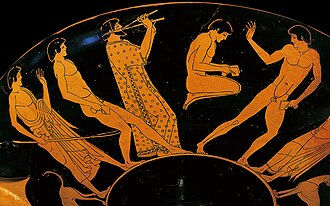
The ancient Games had no soccer or swimming, but there were plenty of events:
Running races: the most famous was the stadion, a 190m sprint.
Long jump, discus and javelin: some jumpers would carry weights to help them swing further.
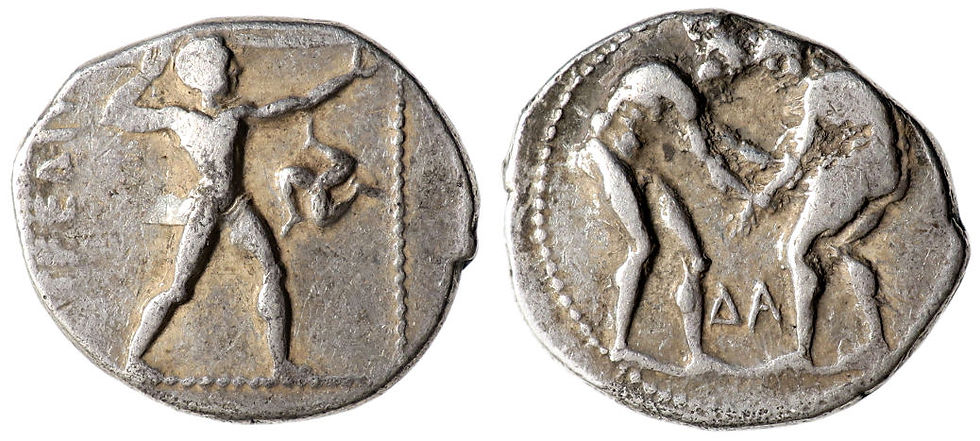
Wrestling and boxing: tough sports with few rules.
Chariot races: teams of horses thundering around the track.
Many athletes competed without clothes, which the Greeks thought was normal at the time.

They would rub olive oil on their skin and scrape it off afterwards as a barrier from the sun, wind and dust. Only free men from Greek cities could compete, and women had their own festival, the Heraia.
The Greeks had a special word, arete (ah-reh-TAY), which means excellence, or becoming the very best version of yourself. The Greeks admired people who balanced a strong body with a thoughtful mind, and Greek schools taught both sports and music and poetry.
Arete wasn't only about winning. A potter could show arete by making a beautiful vase, and a student could show it by working hard on a tricky problem. Greek thinkers believed that a good life mean training your body, your mind and your character. Plato and Aristotle wrote about how to live a good life. Aristotle said that we become excellent through habit: doing good things again and again until they become part of who we are. Getting better involved effort, mistakes, and practice.
Arete wasn't only for humans. The Greeks used the word for a knife that cut well, or a horse that ran fast. What would arete look like for a teacher, a musician or a baker?
Cheating was a serious matter. Athletes had to swear an oath to Zeus that they would play fairly and train properly. Anyone caught cheating was fined, and the fines paid for bronze statues of Zeus, set up along the path to the stadium so the athletes had to walk past them as a reminder.
The ancient Games ran for over 1,000 years. Then they stopped, and for a long time they were almost forgotten. In 1896 they were brought back in Athens as a modern Olympic Games.
Australia has been a part of the story from the start. An Australian, Edwin Flack, won two running events at those first modern Games. Since then, Australia has hosted the Games twice, in Melbourne in 1956 and Sydney in 2000, and Brisbane is next in 2032. Today the Olympic spirit also lives on in the Paralympic Games, where athletes show arete in their own incredible ways.
Think About It
Why do you think the Greeks stopped wars for the Games?
Is trying your hardest more important than winning? Why or why not?
Why does arete look like in school, not just in sport?
Is a fair loss better than an unfair win?
Until next time,
λεῖος πλόος!
Written by Eleanor-Scarlett Russell
Education and Programs Officer
Hellenic Museum


Comments