
Solving the mystery of the Antikythera Mechanism
When divers found a lump of green, crusty metal on the seabed, who knew that it would turn out to be one of the most amazing inventions of the ancient world!

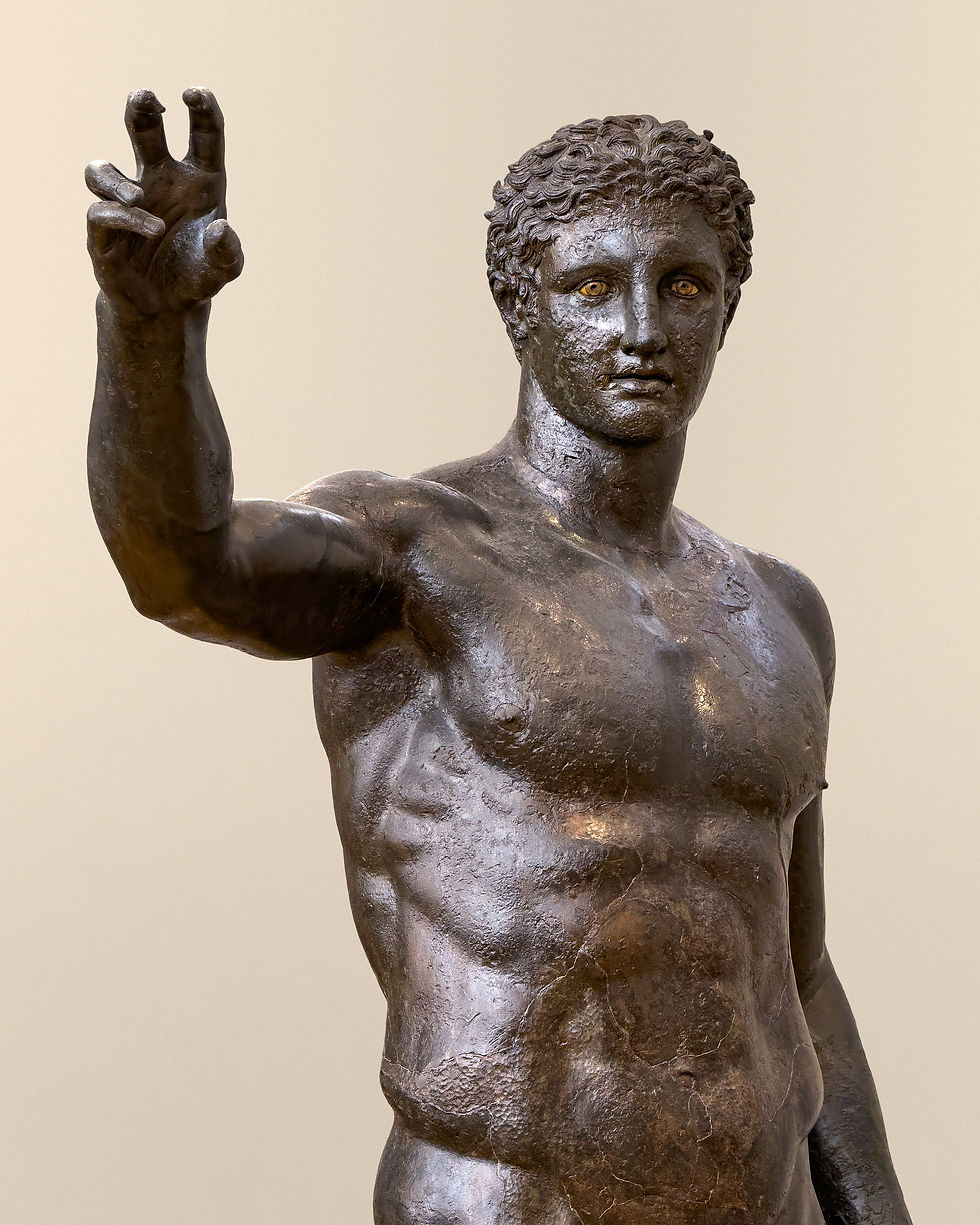
In 1900, a group of Greek sponge divers sheltered from a storm near Antikythera, a tiny island between mainland Greece and Crete. When one diver went down to look for sponges, he came back up terrified. He had seen a pile of bodies lying on the sea bed! They were not real people thankfully, but bronze and marble statues from an ancient shipwreck, lost for about 2000 years. The ship was probably a large cargo vessel, perhaps carrying treasures like glass bowls, fine pottery and luxury goods to Rome.
The wreck was about 45 metres down, which was pretty much the limit of how deep divers could reach in 1900. They would wear heavy canvas suits and brass helmets, and only had minutes at the bottom to recover anything. This expedition is often considered the first major underwater archaeological excavation in history!
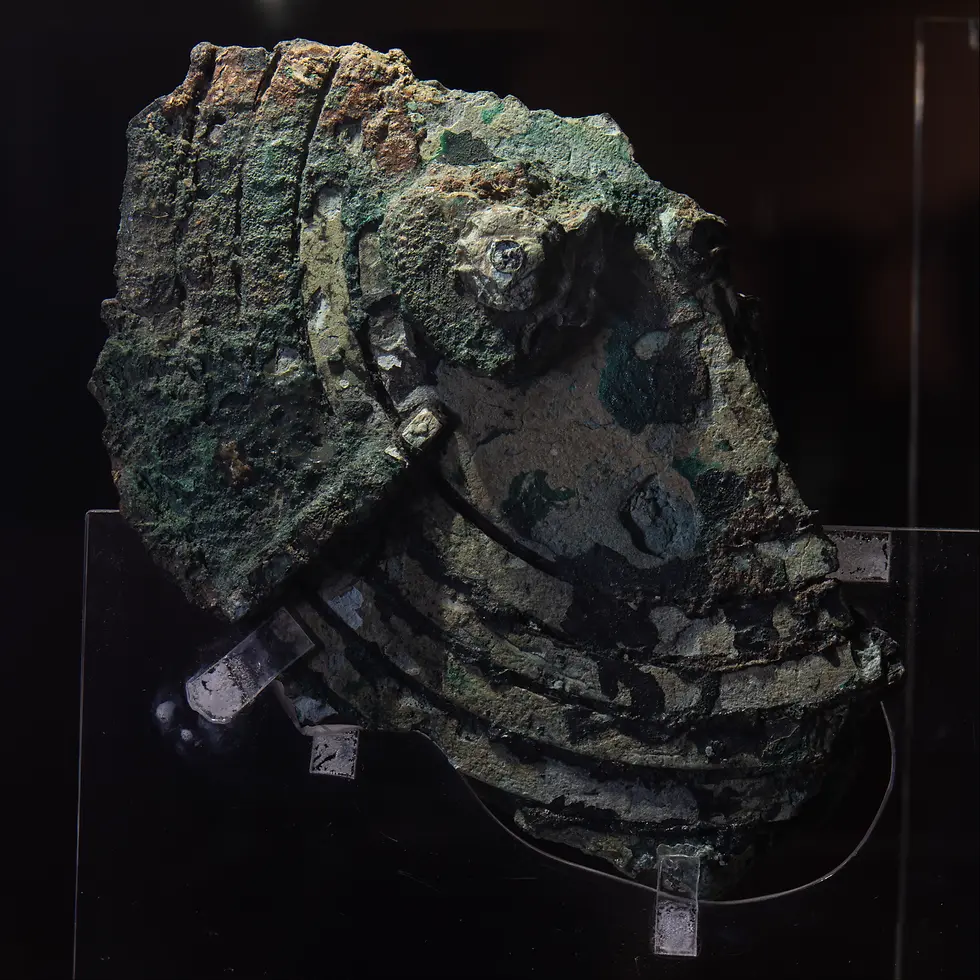
Archaeologists joined the recovery, and the divers brought up statues, jewellery, coins and pottery. One find looked like nothing special: a corroded lump of bronze, about the size of a shoebox, that was put aside. In 1902, archaeologist Valerios Stais examined the lump and inside he could see something astonishing: gears.
Historians were stunned. Nobody believed that the ancient Greeks could make something this complicated!
Gears with tiny triangular teeth, meshed together in layers, were not supposed to exist for another thousand years, in fact nothing as complicated would appear again in Europe until astronomical clocks in the 1300s.
The lump had broken into more than 80 fragments. It took researchers more than a century, and some very clever technology, to work out what is was. The metal was far too fragile to take apart, so scientists in the 1950s used X-rays, and later in 2005 powerful 3D CT scanners, to see inside. The scans revealed more than 30 gears and thousands of tiny letters engraved on the surface, parts of which read like an instruction manual written in Greek.
By piecing it together, researchers worked out that the device was a hand-cranked machine. Turn the handle and the dials would show:
the positions of the Sun and Moon in the sky,
the phases of the Moon,
when an eclipse might happen,
the cycle of the Olympic Games and other festivals.
The Moon's speed in the sky varies, and the mechanism copied this with a clever pin-and-slot gear arrangement, a bit like a tiny puzzle on a gear wheel. The Moon phase display also used a small ball, half silver and half dark, that turned to show the Moon waxing and waning. Some researchers also believed it showed the movements of the planets, and recent computer models suggest that it is possible.


Why would anyone build this? The Greeks watched the sky closely. The calendar mattered for farming, festivals and religion, and eclipses were thought to be important signs. The mechanism let its owner see the heavens in miniature and predict what would happen, long before the events took place.
Experts think it was built around 2100 years ago, probably by Greek scientists and craftspeople, but we still do not know exactly who made it.
The mechanism raises as many questions as it answers:
Who built it, and for whom?
Were there others? Surely a machine this advanced didn't come out of nowhere.
Why were no similar devices found anywhere else?
What is still missing? Many pieces never came up from the seabed.
Divers have returned to the wreck several times, and archaeologists keep finding new objects. The mechanism now sits in the National Archaeological Museum in Athens, where you can see the fragments yourself.

Think About It
Archaeologists often have only broken pieces of evidence. What can you work out from fragments, and what are you only guessing?
What would you have thought the lump was if you'd found it without X-rays?
If a future archaeologist dug up a phone in 2000 years, what might they get right about what it is, and what might they get wrong?
Until next time,
λεῖος πλόος!
Written by Eleanor-Scarlett Russell
Education and Programs Officer
Hellenic Museum


Comments